Facial Exercises and Massage
Face Yoga vs. Facial Massage: What's the Difference?
Compare face yoga and facial massage, including goals, evidence, session length, safety, temporary puffiness, and a practical way to choose between them.
6 min read · Educational guide
Face yoga uses active facial movements; facial massage uses external touch. Either may be an enjoyable self-care practice, but neither is a proven way to remove facial fat or reshape facial bones. Choose based on comfort and your immediate goal: gentle movement for an exercise break, or skin-light touch for relaxation and possibly temporary changes in familiar puffiness.
Face yoga: active movement

Face yoga commonly includes cheek lifts, lip shapes, controlled cheek puffing, relaxation, and posture movements such as small chin tucks. Some programs add resistance or exaggerated expressions, but beginners do not need either.
Its proposed purpose is to train facial muscles or improve awareness of how you hold tension. Those goals are different from fat loss. Repeatedly contracting cheek muscles does not establish that cheek fat will shrink.
The often-cited 2018 JAMA Dermatology pilot reported improved cheek-fullness ratings after a 20-week program. It was small and uncontrolled: 16 of 27 enrolled women completed it. Participants were middle-aged women, and the study did not prove facial fat reduction or a sharper jawline.
Facial massage: external touch
Facial massage covers several approaches, including light hand movements, tool-assisted rubbing, and specialized clinical manual lymphatic drainage. These should not be treated as interchangeable. Medical drainage is individualized care, not simply a beauty routine with a different name.
For home wellness use, choose skin-light contact rather than deep kneading. You may find it relaxing, and it may temporarily change the appearance of ordinary puffiness. It cannot remove fat, permanently lift tissues, or treat the underlying cause of unexplained swelling.
Cleveland Clinic describes lymphatic drainage as gentle and identifies medical situations where it may be unsuitable. A stronger massage is not a more effective version of lymphatic-style touch.
Face yoga and facial massage compared
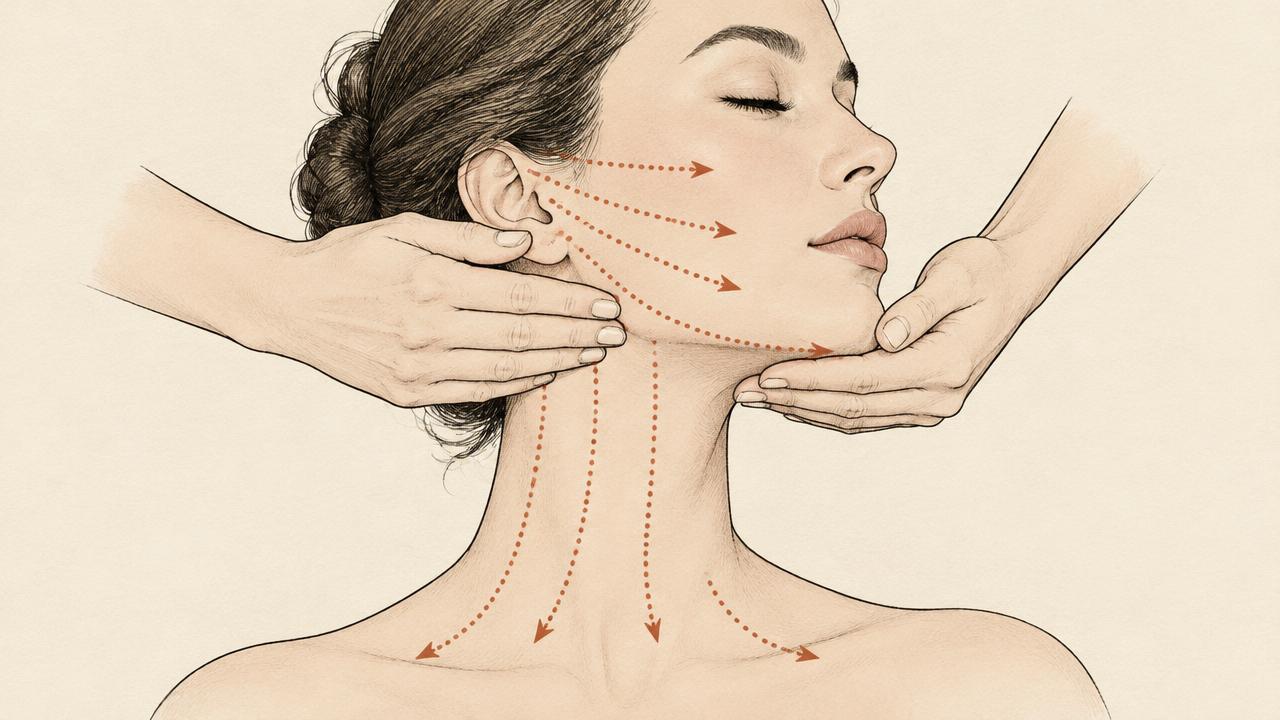
This comparison separates practical differences from uncertain cosmetic claims. Suggested session lengths are conservative beginner examples, not evidence-based doses.
| Feature | Face yoga | Facial massage |
|---|---|---|
| Main purpose | Active movement, muscle awareness, and optional relaxation | Comfort through touch and possible temporary puffiness changes |
| How it is performed | Small expressions, lip movements, cheek exercises, and gentle posture work | Slow surface movements using clean hands and skin-light pressure |
| Typical beginner session | About five minutes with rests; shorter is acceptable | About two to five minutes; no need for repeated passes |
| Potential benefits | Enjoyment, movement practice, and uncertain appearance effects | Relaxation and a possible short-lived change in familiar puffiness |
| Evidence limitations | Small studies and limited generalizability; no established slimming effect | Clinical drainage evidence does not establish cosmetic benefit for every healthy face |
| Fat reduction | Not a proven method of selective facial fat loss | Does not remove or burn facial fat |
| Bone structure | Does not reshape adult facial bones | Does not remodel the jaw or cheekbones |
| Main safety concerns | Jaw clenching, painful clicking, neck strain, and excessive repetition | Skin irritation, pressure on sensitive anatomy, and inappropriate massage of swelling |
| Equipment | None required | Clean hands are enough; tools are optional and not inherently better |
| Reasons to seek guidance | Jaw pain, locking, recent injury, or recent surgery | Unexplained swelling, infection, recent procedures, or relevant systemic conditions |
Which is better for beginners?
Neither is universally better. If you enjoy movement and your jaw and neck are comfortable, try a few small expressions with generous rest. If touch feels soothing and your skin is healthy, a brief light massage may suit you better.
Sensitive or irritated skin may make massage a poor choice. Jaw pain or locking may make facial exercise inappropriate. In those situations, simple breathing and shoulder relaxation can be a better starting point than either full routine.
Avoid choosing based on which feels harder. A strong sensation is not evidence of benefit. For jaw symptoms, NIDCR advises conservative care and reducing habits such as clenching; a cosmetic routine should not become self-treatment.
Which is more relevant to puffiness?
Gentle massage is more directly related to the goal of a temporary change in familiar fluid-related puffiness, but a noticeable effect is not guaranteed. Morning fullness may also settle naturally after you get upright.
Face yoga is not an established depuffing method. Working facial muscles harder should not be used as a response to unexplained swelling. Neither option addresses every possible cause, including allergy, infection, medication effects, or systemic illness.
For lasting facial slimming, neither approach has established selective fat-loss benefits. Bone structure, natural fat distribution, age, and skin all influence appearance. An immediate difference in posture or expression is not proof that anatomy has changed.
Can you combine them?
Yes, if both are comfortable, but combining them is optional and has no established extra cosmetic benefit. Try one minute of relaxed breathing, two minutes of small cheek and lip movements, then one minute of skin-light cheek massage.
Keep your teeth apart during both activities. Do not massage sore muscles aggressively after exercise. If either step causes irritation, jaw discomfort, or headache, omit it rather than balancing it with the other technique.
For massage, avoid the eyes, front throat, deep neck, pulse points, and tender lumps. Skip it with infection, painful skin, unexplained swelling, or recent surgery unless cleared. Ask a clinician first for relevant heart, kidney, clotting, or lymphatic conditions.
Sudden lip, tongue, or throat swelling, breathing difficulty, or faintness requires emergency help. New painful, persistent, or worsening facial swelling needs assessment, not a longer combined routine.
Use structure without chasing a result
The app's exercise library page offers a filterable library with limited free choices, while daily routine provides a daily exercise timer and completion feature. These can help pace a short movement break without proving that the routine changes facial shape.
The massage page page has four timer routines with limited free access. Follow only comfortable, skin-light movements, regardless of stronger wording in a routine. Timers are organizational tools, not instructions to continue through pain.
Choose one approach initially so you can notice how your skin, jaw, and neck respond. Judge it by comfort and enjoyment rather than daily photographs. Doing neither is also a valid choice.
Frequently asked questions
Can either method guarantee a defined jawline?
No. Neither reliably removes facial fat or changes bone structure. Posture, expression, and temporary fluid changes may alter appearance without permanently changing the jawline.
Which should I do first if I combine them?
There is no established best order. Keep both brief and gentle, and avoid rubbing areas that feel sore after movement. You can also alternate days instead.
Is a massage tool better than my hands?
Not necessarily. Hands make light pressure easier to monitor, and tools can encourage scraping or force. No tool is required for a beginner routine.
The takeaway
Choose gentle movement for an enjoyable exercise break or skin-light massage for soothing touch and possible temporary puffiness changes. Neither guarantees slimming, and safety matters more than intensity or completing a timer.
Sources and further reading
- JAMA Dermatology: Association of Facial Exercise With the Appearance of Aging
- Cleveland Clinic: Lymphatic Drainage Massage
- NIDCR: Temporomandibular Disorders
- Cleveland Clinic: Facial Swelling
General wellness information, not a diagnosis or individual medical advice. A healthcare professional can advise on unexplained swelling, pain, medical conditions, or recovery after treatment.