Facial Puffiness and Lifestyle
How to Track Changes in Your Face Without Obsessing Over Appearance
Build a body-neutral approach to facial changes with optional, infrequent photos, useful habit tracking, and clear boundaries for protecting your wellbeing.
6 min read · Educational guide
The healthiest way to track facial changes is to make appearance monitoring optional, infrequent and secondary to wellbeing. If photographs help, use consistent conditions and review them occasionally rather than comparing daily. Focus mainly on comfortable routines, energy and health habits. Stop tracking if it increases distress, compulsive checking or pressure to change your body. You do not need progress photos to benefit from healthy habits.
Why your face does not look identical every day
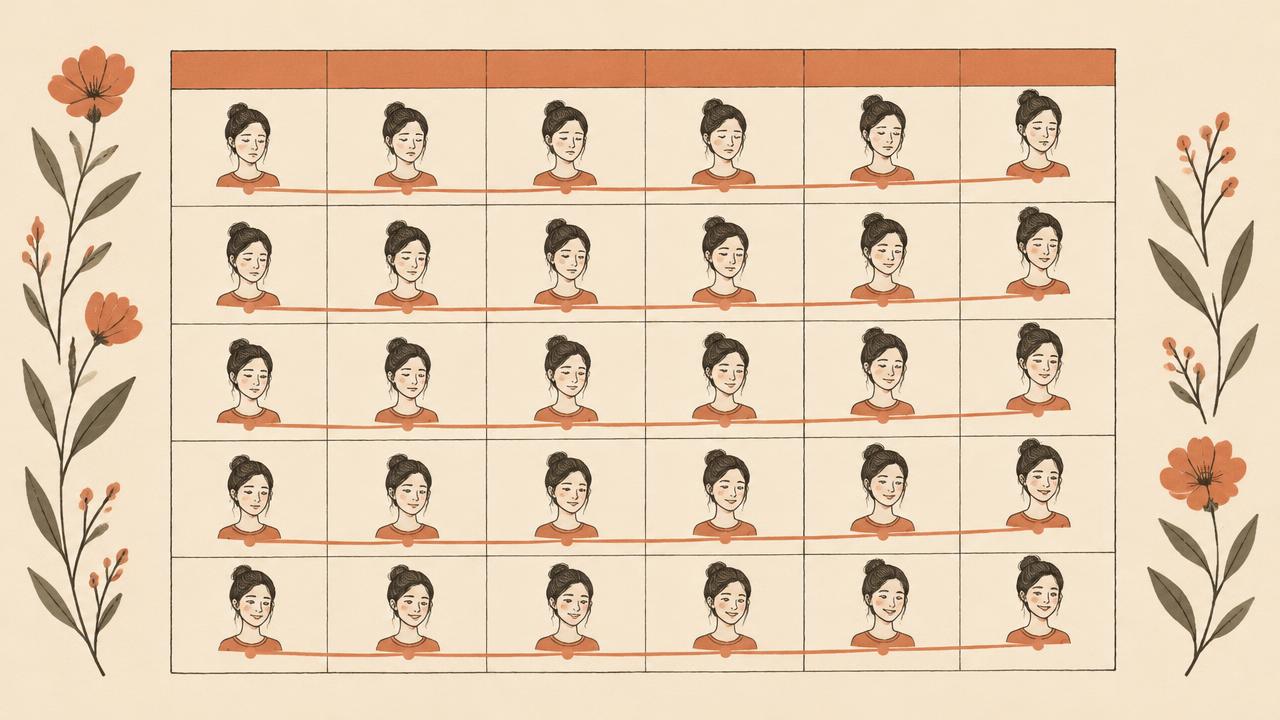
Facial appearance changes with expression, sleep, temporary fluid shifts, allergies and ordinary variation. A morning photograph and an evening photograph may look different without any meaningful change in body composition. Natural asymmetry is also common; faces are not meant to resemble perfectly mirrored images.
Photography adds another layer. Close camera distances can alter proportions, overhead light creates shadows, and tilting the chin changes the jawline's appearance. Filters, portrait effects and automatic processing can further change the result. A more dramatic photograph is not necessarily a more accurate one.
The number on a scale cannot explain every facial change either. Weight does not identify the distribution of facial tissue, distinguish swelling from fat or measure wellbeing. Avoid adding weigh-ins simply because photographs feel inconclusive.
Recognise when tracking stops serving you
Checking can become a loop: you notice a possible difference, inspect it more closely, feel uncertain and check again. More images do not necessarily settle that uncertainty. Zooming into small details can shift attention away from how you feel and what you want to do with your day.
The NHS identifies repeated mirror checking, appearance comparisons and significant preoccupation with perceived flaws as possible features of body dysmorphic disorder. Having an appearance concern does not automatically mean you have this condition, but distress and interference with daily life deserve support.
Useful warning signs include retaking photos until they feel acceptable, asking for reassurance repeatedly, avoiding social plans because of your face, or changing food and exercise to compensate for a photograph. You do not have to wait until these behaviours become severe to ask for help.
How to Track Progress in a Balanced Way

Start by deciding whether tracking has a useful purpose. If the answer is mainly to prove that your face is acceptable, photographs are unlikely to provide lasting reassurance. Choosing not to track is a valid and often simpler option.
Choose a non-appearance goal
Examples include completing a comfortable routine occasionally, making time for enjoyable movement or feeling less rushed at bedtime. A facial measurement is not needed to validate these goals.
Set an infrequent review point
If you choose photographs, leave substantial time between reviews—for example, several weeks rather than each morning. This is a boundary, not a required schedule. Skip or stop reviews if they feel unhelpful.
Keep conditions reasonably consistent
Use similar lighting, camera distance, height and angle, with a relaxed expression and no filters. Take one straightforward image rather than searching for the most flattering or least flattering version.
Avoid detailed inspection
Do not zoom, measure tiny differences, draw jawline outlines or repeatedly switch between images. Photography cannot reliably establish changes in fat or diagnose swelling.
Check the effect on your wellbeing
After reviewing, ask whether the process helped you make a useful decision or simply increased worry. Stop if it triggers distress, compulsive checking or restrictive behaviour.
Healthy Things to Track Instead
A small number of flexible observations is usually more useful than a dashboard full of targets. Include rest and enjoyment, not just completed tasks.
CDC describes sleep benefits in terms of health, mood, attention and functioning rather than a particular appearance. That is a useful model for evaluating other habits too: ask what they contribute to your life, not whether they make your face smaller.
- Exercise consistency: whether movement felt manageable and enjoyable, not whether it compensated for eating.
- Sleep habits: whether you allowed enough rest and how refreshed you felt. Record this separately if helpful; the app has no sleep logger.
- Hydration habits: whether you had reasonable access to drinks and followed individual advice, without forcing intake to meet a generic target.
- General energy: whether you could concentrate, participate in daily activities and recover comfortably.
- Routine flexibility: whether you could take a break without guilt and return when it suited you.
Use app features without turning them into obligations
The daily routine page provides timed exercises and completion tracking. Use those tools only if the routine feels comfortable and worthwhile. Completion is not evidence of fat loss, and a missed day does not erase anything beneficial you have done.
The progress page page includes streaks and optional photo comparisons. You can leave photos unused. If streaks create guilt or comparisons encourage checking, step away from those features—or the app entirely. There is no need to maintain a record for its own sake.
Avoid comparing your face with other people's faces, including edited social-media images. Different anatomy, expressions and photography conditions make these comparisons misleading, and they rarely help you choose a healthier next step.
Know when to seek support instead of more data
Speak with a qualified mental health professional or primary-care clinician if appearance worries occupy substantial time, checking feels difficult to resist, or eating and exercise become restrictive or compensatory. Evidence-based support is available. If you feel at risk of harming yourself, seek immediate local crisis or emergency help.
Do not use a tracking schedule to postpone care for actual swelling. Seek prompt assessment for sudden, painful, severe or one-sided swelling, fever, redness, eye pain or vision changes; arrange routine care for persistent or unexplained changes. MedlinePlus recommends assessment for lasting or worsening facial swelling.
Call your local emergency number for sudden lip, mouth, tongue or throat swelling, difficulty breathing or swallowing, or collapse. A photograph is not required before seeking help.
Frequently asked questions
Do I need before-and-after photographs?
No. Photos are optional and cannot prove health improvements or identify the cause of facial fullness. Routine consistency, comfort and daily functioning can be worthwhile outcomes without any visual record.
How often should I compare my face?
There is no medically required comparison schedule. If you choose to use photos, review infrequently rather than daily and stop if the process increases worry. A suggested interval is not a reason to keep tracking when you would rather stop.
What should I do if I keep checking despite wanting to stop?
Pause appearance tracking and seek professional support, especially if checking affects eating, sleep, work or relationships. Tell the clinician how much time it takes and what happens when you try to resist. You do not need to diagnose yourself first.
The takeaway
Tracking should make life easier, not make your face a constant project. Keep photographs optional, prioritise flexible health habits and stop monitoring when it causes distress. Your wellbeing matters more than a comparison image or streak.
Sources and further reading
General wellness information, not a diagnosis or individual medical advice. A healthcare professional can advise on unexplained swelling, pain, medical conditions, or recovery after treatment.